
Animal protein for the meat industry is one of the main components in the manufacture of semi-finished products, sausages and other meat products. Beef collagen has a number of advantages over other types of protein: it is a 100% meat replacer, forms the structure of the final product, has the nutritional properties of the original raw material and contains essential amino acids. Below: what beef collagen protein is, its role in meat production, dosages and the benefits of its use.
Collagen protein of animal origin is the main structural component of animal connective tissue and is widely used in the food industry. Beef collagen protein is obtained by processing the cattle tissues richest in collagen: over 90% of the mass of this component is protein fiber. The product is especially in demand in the production of meat and dairy products.
High-quality beef collagen protein has a neutral odor and taste. The shade of the dry powder or powdered fibers is creamy white or milky white; the final color depends on the presence of pigment spots in the cattle raw material. Low fat and moisture content ensure product stability and shelf life.
Beef protein for meat products is in high demand in food manufacturing. Functional cattle proteins give producers the opportunity to reduce the cost of their products while improving quality, by introducing natural beef protein into the formulation instead of less natural additives.
Beef protein is indispensable in meat processing for the manufacture of:
frankfurters, wieners, meat loaf and cooked sausages of various grades;
semi-smoked, raw-smoked and cooked-smoked sausages;
whole-muscle beef products and semi-finished products;
dumplings, khinkali, pâtés, minced meat and canned meat.
In addition, collagen proteins are used in the production of natural premium and holistic pet foods, which contain only natural components with a high content of animal proteins.
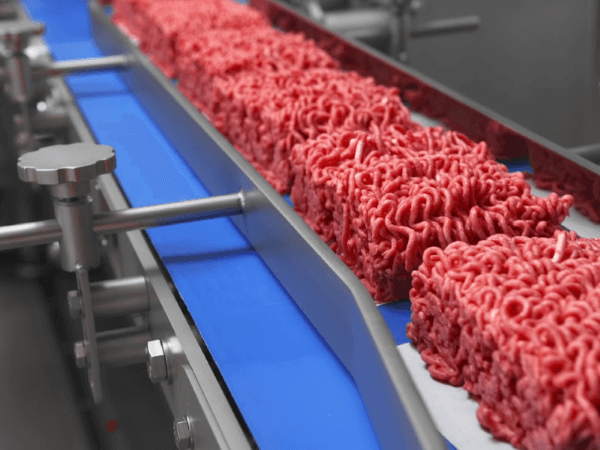
Including beef protein in finished meat products gives them a high protein and energy value, similar to that provided by whole-muscle meat. Beef protein for meat production is a natural 100% meat replacer that combines well with the other ingredients of the formulation and serves as a healthy alternative to non-natural fillers.
Enterprises use different formulations with added beef protein; in some cases the formulation is unique and confidential. Average proportions of dry protein use:
| Average dosages of beef collagen protein in meat production | |
|---|---|
| Method of use | Dosage |
| Formulation component enhancing the sensory properties of whole-muscle meat products | 0.5–4% dry protein of the total product volume |
| Mixing minced meat for sausages and semi-finished products | up to 20% hydrated protein |
| Processing additive without hydration or with minor hydration | up to 1.5% dry protein |
A share of animal protein in minced meat within the specified limits makes it possible to achieve the optimal texture and taste characteristics of the final product.
The capability of beef protein lies not only in improving the sensory properties of meat products, but also in reducing losses during subsequent heat treatment and storage. In addition, the protein can serve as a substitute for various thickeners, improving the forming of minced meat in sausages and frankfurters. High-quality animal protein in minced meat stabilizes its structure, prevents separation and ensures even moisture distribution throughout the mass.
Due to its natural origin, beef collagen protein significantly improves the sensory characteristics of the finished product, and thanks to its structure it acts as a structure-forming and stabilizing ingredient. Adding the protein at the production stage gives the following results:
Raw material properties. Binds excess moisture, increases the protein level, reduces ash content, stabilizes pH and optimizes drying conditions for raw-smoked and dry-cured sausages.
Yield and cost. Reduces cooking losses, increasing the yield of finished products, which lowers the cost of meat products.
Freezing and storage. Reduces losses during freezing and storage of finished meat products, stabilizing the shape and appearance of the product.
Structure. Improves the density and integrity of whole-muscle semi-finished products.
Vacuum packaging. Minimizes the risk of broth-fat pockets and moisture release (syneresis), which reduce the consumer appeal of vacuum-packed products.
Calorie content. Stabilizes the calorie content of meat products, making it possible to produce dietary products from natural components with full flavor and aroma.
In meat products, beef protein combines well with soy, milk and egg protein and with carrageenan, improving the taste and consistency of the products.
Beef collagen protein is added to minced meat in pre-hydrated form. The hydration level is given as a range because it depends directly on the moisture content of the meat raw material: the more moisture in the meat or minced meat, the less water is added when diluting the protein. If the raw material has little moisture, hydrate at the upper limit (1:15); if it has a lot, at the lower limit (1:9). With medium moisture content, the technologist selects hydration in the 1:10–1:14 range.
| Process parameters for using BioPro beef collagen protein by type of meat product | |||
|---|---|---|---|
| Product type | Hydration (protein : water) | Dosage | Stage of addition |
| Dosage: cooked sausages, hams, canned meat, semi-finished products | 1 : 9–15 | up to 30 kg of hydrated protein per 100 kg of meat batter | first stage of cutting or mixing (onto lean meat raw material) |
| Dosage: cooked-smoked and semi-smoked sausages (hydrated protein) | 1 : 9–15 | up to 30 kg per 100 kg of meat batter | first stage of cutting or mixing |
| Dosage: cooked-smoked and semi-smoked sausages (as granules) | 1 : 10–12 | up to 25 kg per 100 kg of meat batter | for structure — first stage of cutting; for the pattern on the cut — final stage |
| Dosage: canned meat | 1 : 6–10 | up to 30 kg per 100 kg of meat batter | first stage of cutting or mixing |
| Dosage: minced semi-finished products in dough (dumplings, manti, chebureki) | 1 : 6–8 | up to 30 kg per 100 kg of meat batter | first stage of cutting or mixing |
| Dosage: minced semi-finished products (cutlets, meatballs, patties) | 1 : 6–8 | up to 30 kg per 100 kg of meat batter | first stage of cutting or mixing |
| Dosage: raw-smoked sausages | 1 : 6–8 (as granules) | up to 30 kg per 100 kg of meat batter | first stage of cutting or mixing |
| Dosage: pre-curing of raw material for cooked-smoked sausages | 1 : 9 | up to 20 kg per 100 kg of meat batter | during mixing in the mixer |
| Dosage: mechanically deboned poultry meat (MDM) | 1 : 10 | up to 20 kg of hydrated protein per 100 kg of minced meat | during mixing in the mixer before freezing |
| Dosage: protein-fat emulsion (PFE) | protein : water : fat : emulsifier = 1 : 17 : 17 : 0.5 | up to 25 kg per 100 kg of meat batter | final stage of cutting |
| Dosage: whole-muscle delicacies (injection brine) | 2–3 kg of protein per 100 L of brine | 2–3 kg of protein per 100 L of brine | first stage of brine preparation |
Addition technologies differ between enterprises. Some producers pre-hydrate with cold water at the end of the shift and put the gel in the refrigerator overnight: by morning the meat gel has already formed and is loaded into the grinder or cutter together with the base minced meat. Others pour the protein from the bag directly into the cutter and mix it with the ready minced meat, usually when short of time, staff or free refrigerator space.
The recommended method is to hydrate in advance with cold water and hold at +4…+6 °C overnight. This process makes beef collagen protein more functional: the fibers have time to become fully wetted, and the protein works to its full potential.
Granules are used in cooked-smoked, semi-smoked and raw-smoked sausages to replace meat raw material and obtain an even pattern on the cut.
| Granule production recipe (per 100 kg) | |
|---|---|
| Component | Quantity, kg |
| Water (temperature not less than 88 °C) | 90.7 |
| Beef collagen protein | 9 |
| Colorant (e.g. fermented rice) | 0.3 — as recommended by the manufacturer |
| Total | 100 |
In a container with hot water at not less than 88 °C (90.7 kg), stir in the fibrous protein at a ratio of 1:10 (9 kg), adding the colorant (carmoisine, fermented rice).
Leave the mass to swell in a room at 12–16 °C for 2 hours.
Pour into trays and let it “mature” at 4–6 °C for 8–12 hours. During cooling it is recommended to stir the mass 2–3 times so that the protein does not settle to the bottom.
Grind in a cutter or grinder to the required size of 3–5 mm.
Accelerated procedure: if granules are needed quickly, the cooling time can be roughly halved by replacing ¼ of the water with snow. The protein is thoroughly mixed with the hot water, after which the remaining quarter is added as snow.
PFE makes it possible to stabilize fat-containing raw material in the formulation and is produced by the cold method.
| Protein-fat emulsion recipes | ||
|---|---|---|
| Component, kg | Recipe No. 1 | Recipe No. 2 |
| Raw pork, poultry or beef fat | 50.0 | 25.0 |
| Poultry skin, pork rind | — | 25.0 |
| Beef collagen protein | 3.0 | 3.0 |
| Water | 50.0 | 50.0 |
| Emulsifier | 1.5 | 1.5 |
| Total | 104.5 | 104.5 |
Cold water or an ice-water mixture is poured into the cutter.
The protein and emulsifier are added in dry form and mixed at low knife speed for 30 seconds.
The fat-containing raw material is added and processed at maximum speed until a stabilized emulsion is obtained.
The finished emulsion is unloaded into containers and stored at 0…+4 °C for no more than 48 hours.
Recipes may vary depending on the equipment available at the enterprise, the technical conditions of production and the ingredients used.
Beef protein is used as a protein enrichment for brines in the production of cooked-smoked whole-muscle delicacies from pork, beef, horse meat and chicken: ham, brisket, neck, loin.
| Approximate brine recipe (per 100 L) | |
|---|---|
| Component | Quantity, kg |
| Beef protein (powder) | 2.0 |
| Citrate | 1.0 |
| Guar + xanthan gum | 0.06 |
| Salt | 1.5 |
| Water | 70 |
| Snow | 30 |
| Total | 104.56 |
Preparation procedure: use a separate container for 100 kg of brine. First hydrate the protein in 70 liters of water, then add the remaining components, with the snow added last. Result: a 3–10% increase in finished product yield compared with the standard, a dry cut surface and reduced moisture loss during vacuum packaging.
| Recipe for curing meat raw material with beef protein (per 100 kg) | |
|---|---|
| Component | Quantity, kg |
| Meat raw material (beef, pork) | 78 |
| Beef collagen protein | 2 |
| Water | 18 |
| Salt | 2 |
| Total | 100 |
Result: increased water-binding capacity (WBC) of the minced meat, stickiness and other functional and technological properties of the raw material.
Working with the protein does not in itself increase costs: at the minced meat preparation stage there is always an opportunity to increase the amount of protein in the formulation if there is a lot of moisture. But there are three mistakes that prevent the technologist from getting results.
Incorrect calculation of moisture in the minced meat. The more moisture in the minced meat, the more protein needs to be added. This is the key parameter on which the entire dosage depends.
Water not hot enough when producing granules. Granules made from pure beef collagen protein require only hot water at not less than 88 °C. No foreign substances are added to the protein that would make it set into a gel in warm or cold water: the higher the processing temperature, the higher the functionality.
No holding in the refrigerator. A +4…+6 °C regime is mandatory. If you made granules at 1:10 with hot water: stir and refrigerate for 8–12 hours. If you pre-hydrated with cold water at 1:8: likewise stir and refrigerate for 8–12 hours.
Roasting and smoking. Product roasting time is reduced, and smoke is deposited more evenly during smoking.
Appearance and casing. The appearance of the product improves and casing removal becomes easier.
Sliceability. Cold sliceability of products improves.
Taste. The product’s taste becomes more pronounced. When fatty raw material is used, the greasy aftertaste is reduced thanks to the emulsifying properties of the protein.
Vacuum packaging. Moisture loss during vacuum packaging is reduced.
Microbiology. The risk of microbial spoilage is reduced; in raw-smoked sausages the water activity (aw) is lowered.
Equipment. Less minced meat sticks to the forming parts, and the forming process improves.
Economics. The yield of finished products increases due to reduced losses during heat treatment and storage.
The BioProFood range includes two native collagen proteins. Their applications are almost identical, as both are suitable for most types of meat and dairy products, but they differ in structure and particle size.
BioPro-B is a native protein produced from cattle connective tissue with the fibrous structure preserved. The fibers act as reinforcement in the product: this produces a denser and stronger meat gel, and the functionality of BioPro-B is somewhat higher than that of powdered protein. It has high hydration, retains moisture and fat, serves as an effective emulsifier and stabilizer, and retains its properties during freezing and heating.
| Characteristics of BioPro-B native beef collagen protein | |
|---|---|
| Parameter | Value |
| Product form | native fibrous powder, “medium fiber” |
| Average particle size | 250–300 µm |
| Protein content in dry matter | not less than 90% |
| Use in meat production | sausages, frankfurters, canned meat, semi-finished products |
| Packaging | paper bag, 8 kg net |
| Shelf life | 12 months |
| Minimum order | 1 bag |
BioPro-A is a premium-grade collagen protein consisting of 100% beef collagen. It is a finely dispersed powder of white or light cream color with a neutral odor. It stabilizes consistency and serves as an emulsifier.
| Characteristics of BioPro-A beef collagen protein | |
|---|---|
| Parameter | Value |
| Product form | finely dispersed powder, white or light cream in color |
| Average particle size | 100 µm |
| Protein content | not less than 90% |
| Collagen content | not less than 70% |
| Dosage in meat production | from 0.5% of the formulation |
| Packaging | paper bag, 20 kg net |
| Minimum order | 1 bag |
LLC “TPP BioProFood” uses domestic raw material in production: cattle hide split. The raw material comes from Russian plants and meat processing facilities and undergoes strict incoming inspection, guaranteeing the quality of the final product.
Gentle processing technology preserves the natural properties of collagen: the fibrous structure of the protein and its natural functionality are not destroyed. Production is located in the Moscow Region and operates around the clock under HACCP control.
The plant has been operating since 2014 and has specialized in beef collagen protein as a single product for more than 10 years. This specialization makes it possible to maintain stable quality and continuously control product safety. A wide network of partners throughout Russia confirms the demand for the product.
Quality control. Production operates on HACCP principles. Every batch of incoming raw material and finished protein is tested in the laboratory.
Halal certification. The enterprise is Halal certified: the requirement applies not only to the finished product but to production as a whole.
Domestic raw material. Only Russian raw material is used in production: cattle hide split. Every batch undergoes incoming and veterinary inspection.
Team and service. A qualified team of technologists and a customer-focused approach are additional advantages of working with the plant.
One of the best solutions for the food industry is the beef collagen protein for meat products BioPro-B. It is a Russian-made native beef protein containing not less than 90% protein in dry matter and supplied as a fibrous powder with a neutral odor.
Beef collagen from BioProFood is a natural Russian product that improves the quality of meat products and significantly reduces production costs. The protein is used not only in the meat industry but also in the dairy industry, in the production of cottage cheese, yogurts, sour cream and ice cream.
The full range and specifications are in the beef protein catalog.
Would you like to learn more about our products or select a protein for your formulation? Write to us: the BioProFood team will prepare a technical and commercial proposal and free samples for a trial production run.
IF YOU WANT TO KNOW MORE ABOUT OUR PRODUCTS — WRITE TO US AND WE WILL DEFINITELY REPLY
 Website support
This website uses cookies to collect visit statistics. Learn more in our Personal Data Processing Policy and Personal Data Processing Consent.